
The three layers of smart metering operations platforms
Smart metering software works in three layers. The head-end system (HES) talks to the meters. The meter data management system (MDMS) turns raw readings into billing-quality data. The operations layer, often called a Smart Meter Operations Centre (SMOC), sits above both. It joins them up with network, GIS, ADMS and field data so a team can find the real cause of a problem, fix it remotely where possible and prove performance. Most utilities need all three. Multi-vendor estates feel the gap at the third layer first.
01The layers at a glance
Each layer answers a different question. The head-end asks whether a meter can be reached. The MDMS asks whether the data is good enough to bill. The operations layer asks why something is failing and what to do about it.
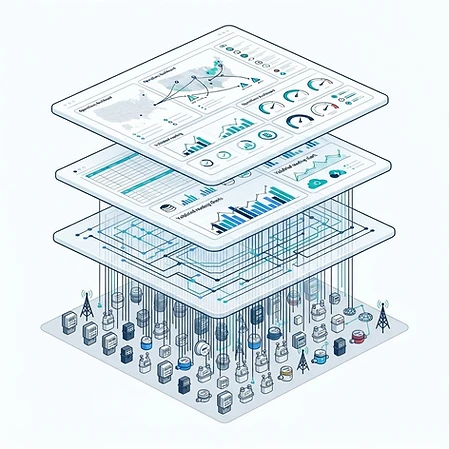
| Layer | Main job | Typical systems | Who works in it |
|---|---|---|---|
| 1. Head-end system (HES) | Talks to meters: collects reads and events, sends commands, manages keys and firmware delivery for the devices it supports. | Vendor head-end systems, multi-vendor or universal head-ends | Metering engineers, network and comms teams |
| 2. Meter data management (MDMS) | Turns raw reads into billing-quality data: validation, estimation and editing (VEE), storage, and delivery to billing and settlement. | Enterprise MDMS platforms | Data and billing operations teams |
| 3. Operations layer (smoc.cloud) | Runs the estate: correlates meters, networks, head-ends, MDMS, GIS and ADMS to find the real cause of a fault, act on it remotely and prove SLA performance. | Vendor-neutral smart metering operations platforms such as smoc.cloud | AMI operations centre, field planning, service and SLA owners |
02Layer 1: the head-end system
The head-end system is the communication layer. It schedules and collects reads, receives alarms and events, sends commands such as on-demand reads, disconnects and configuration changes, and delivers firmware and security keys.
Most head-ends are supplied by a meter or network vendor and are strongest with that vendor's devices. Multi-vendor head-ends exist, but they are still communication systems: they know whether a device answered, not whether the cause was the cellular network, a feeder outage or a firmware batch.
03Layer 2: meter data management
The MDMS receives readings from one or more head-ends and makes them fit for billing and settlement. It validates, estimates and edits data, stores interval history and passes results to billing, customer and market systems.
An MDMS is very good at spotting that a read is missing or suspect. It is not designed to diagnose why, or to trigger remote action across the estate.
04Layer 3: the operations layer
The operations layer runs the estate day to day. It brings in events and KPIs from every head-end, data-quality signals from the MDMS, and context from networks, GIS, ADMS and field systems, then normalises them into one model using standards such as DLMS/COSEM, IEC CIM and MultiSpeak.
On that model it correlates alerts to root causes, opens and tracks triage cases, triggers remote re-reads and resets, plans firmware campaigns, dispatches field work only when needed, and records SLA and audit evidence. smoc.cloud is a vendor-neutral platform for this layer.
05Head-end system vs operations layer
A head-end system manages communication with meters, usually for one vendor family. It answers "did this device respond, and what did it send?". An operations layer manages the whole estate across every head-end. It answers "why are these devices failing, what is the cheapest fix, and are we meeting our SLAs?".
The head-end owns the connection to the device. The operations layer owns the outcome. That is why an operations layer does not replace a head-end: it makes several of them work as one.
06How the layers work together
A typical fault flows through all three. The head-end reports missed reads, the MDMS flags the gaps, and the operations layer correlates them with a cell outage and a firmware version, re-reads the meters remotely and only sends a crew to the few devices that need one.
Because the operations layer sits above the others, a utility can add or change head-end vendors without retraining operations teams or rebuilding its KPIs.
- 01 · HES
Reports missed reads and comms alarms.
- 02 · MDMS
Flags gaps and estimates for billing.
- 03 · Operations
Correlates with a cell outage and firmware version.
- 04 · Operations
Triggers remote re-reads through the head-end.
- 05 · Operations
Sends a crew only to the few meters that need one.